
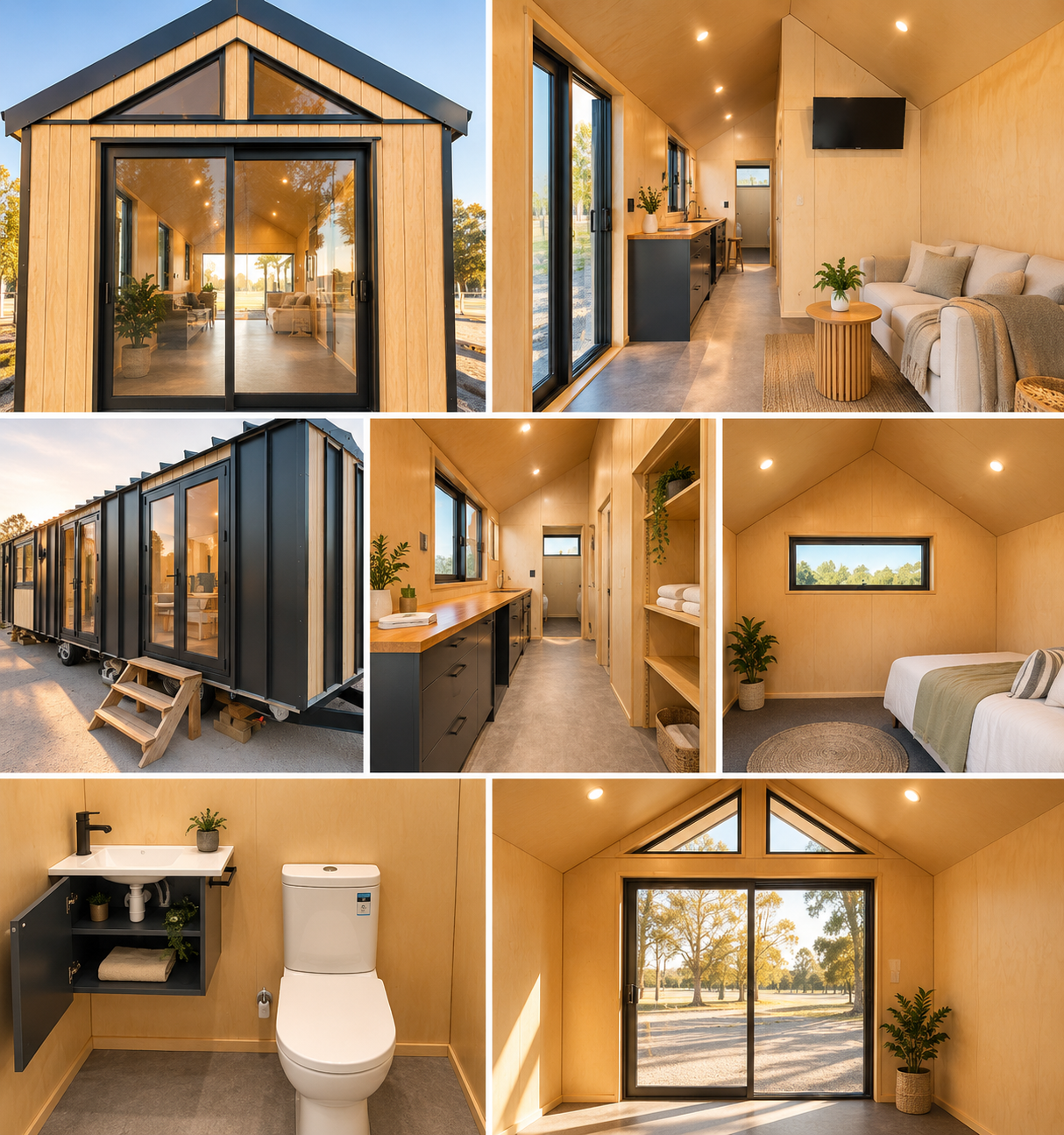
Kerikeri, Far North — The Kea, 12x3, built to be let
Megan didn't email us to buy a tiny home. She emailed to ask whether the council would let her have one.
Who Megan is
Megan and her partner have a property on Access Road in Kerikeri with room on it doing nothing. In January 2025 she sent us a two-line enquiry under the heading "Resource Consent Services": they were looking at putting a tiny home on the property to rent as a BnB, and could we help work out whether that was even possible.
She wasn't asking for a quote. She was asking whether the idea was legal.
What she decided
We rang the Far North District Council and asked the question properly. The answer came back in two parts.
A tiny home with a bathroom and a full kitchen needs a full resource consent application. A tiny home with a bathroom and a kitchenette — no built-in oven, but a microwave, a kettle, a hob, an outdoor barbecue, anything moveable — does not.
For a short-stay rental, the second option is not a compromise. It is how a very large number of Airbnb listings are already set up, and it is arguably better for the job: less to clean, less to break, less to replace between guests.
Megan chose it in a single email.
"Amazing! Go ahead with the basic kitchenette! Do you wanna send through the documents that we need to sign and let's start this!"
No consent application. A cheaper build. Three weeks from her first email to a signed contract.
Designed for guests, not for owners
Her home is a Kea — 12 metres by 3, timber framed, fully insulated, double glazed, birch ply walls with a negative detail, and a mix of Colorsteel and timber on the outside.
Inside, almost every decision was made for turnover rather than for living in. A kitchenette with white fronts, a bamboo bench and no overhead cabinets. An under-bench fridge, a two-burner gas hob, a dish drawer. Black tapware throughout. A 1200x900 shower with a glass wall. Nothing fussy, nothing with a hundred edges to wipe down.
Then came the part nobody puts on a spec sheet: the site. From March to June we worked alongside her on drainage, the drainlayer, the septic system, the electrician, the earthworks and the ground screws. That is where the months went, and it is the part most first-time buyers do not see coming.
While that was happening, we sent Megan a set of images of a home that did not exist yet, so she could build the Airbnb listing and start taking bookings before delivery. Once the home was finished, we had it professionally photographed and virtually staged: real rooms, furniture added digitally. She was in Fiji when the photographer came. The key was in the lockbox.
Then the sea closed
Her home reached Picton and stopped. Every Cook Strait ferry service was suspended for weather, and it sat in the queue waiting for the sea to calm down. There was nothing anyone could do about it.
Megan had landed back in the country two days earlier and was flat-out jet-lagged. Her reply:
"No that's fine! I had wondered if that would happen, no stress!"
It crossed a few days later. Adam connected the plumbing, the water tank arrived, the deck went on in July, and the listing went live in August.
Where it is at
The Kea is running as a short-stay rental in Kerikeri and paying for itself. We have since used it as a competition prize, and we send prospective clients in the Far North to go and stand inside it — because a photo of a tiny home tells you very little, and ten minutes in one tells you everything.
Megan got an income stream on land she already owned, without a resource consent application, and Ruru got a showroom at the top of the country.
What this taught Ruru
The first question is usually not "what does it cost". It is "am I allowed". Megan's whole project turned on one phone call to a council, and that call took twenty minutes.
We also learned that a home built to be let is a genuinely different brief from a home built to be lived in, and that saying so out loud early — fewer cupboards, simpler kitchen, harder surfaces — makes for a better building and a happier owner.
Sitting on land you could be earning from? Ask us the consent question first. It is usually one phone call, and it changes everything that follows.